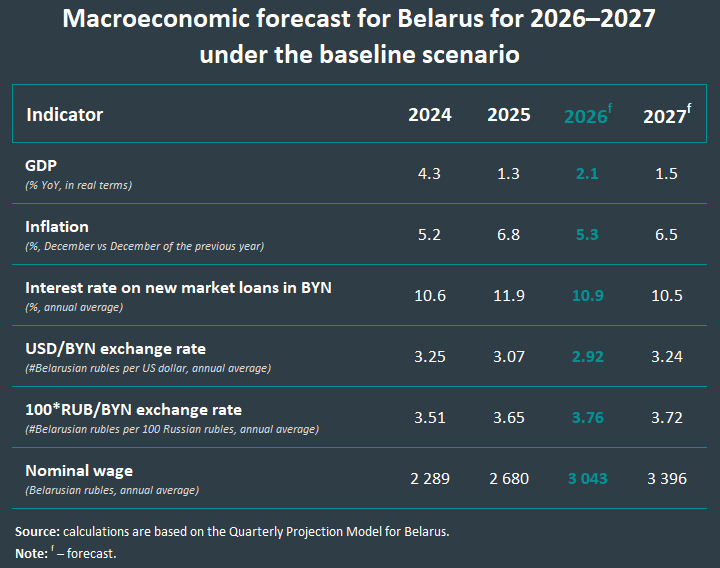
Belarus’s economy will grow at a moderate pace in the medium term, provided that external conditions do not deteriorate significantly
GDP will grow by 1.5–2.5% and exceed $100 bn in 2026. The economy accelerated to ≈3% YoY in Q2-2026 (after a decline of 0.2% YoY in Q1) and will maintain annual growth of around 2–3% YoY in H2. This will be supported by accommodative economic policy, directed investment stimulation, a moderate recovery in demand from Russia, and idiosyncratic factors (primarily favorable terms of trade and high volumes of tolling oil processing). The state of domestic demand remains unbalanced, which, combined with the economy’s vulnerability to external shocks, generates output volatility and a periodic need for policy intervention to contain imbalances. GDP growth will slow to 1.5% in 2027, conditional on fiscal policy shifting to a neutral impulse and the exhaustion of idiosyncratic factors.
Elevated domestic demand and wage growth outpacing labor productivity are generating moderate inflationary pressure. However, inflation will remain around 5–6% YoY in 2026 and 6–7% YoY in 2027, supported by price controls and an exchange rate close to equilibrium. Strict price controls alongside accommodative economic policy are leading to the accumulation of an inflationary overhang, which narrows the room for maneuver in the event of an adverse external shock. Favorable terms of trade will keep the foreign trade position in a small deficit of about 1% of GDP in 2026-2027. Combined with a high household savings rate in rubles, this will keep the dynamics of the Belarusian ruble (in basket-of-currencies terms) close to its equilibrium path in 2026–2027. Forecast uncertainty remains high, primarily due to the instability of external conditions.